1. Engineering Overview & How the Circuit Works
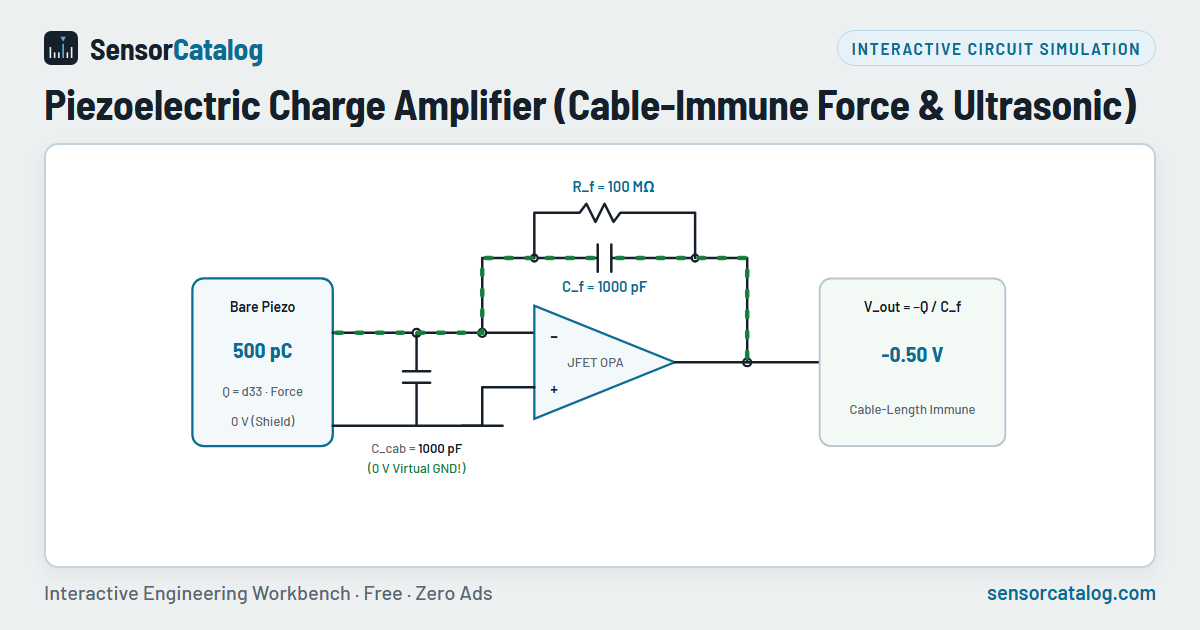
Unlike IEPE accelerometers with built-in electronics, bare piezoelectric crystals (force washers, ultrasonic transducers, high-temperature >250 °C vibration sensors) output pure electric charge Q (pC). A Charge Amplifier integrates Q across feedback capacitor C_f (V_out = −Q / C_f), making sensitivity 100% immune to coaxial cable length!
Cable-Capacitance Immunity: Because the op-amp inverting (−) terminal is held at 0 V virtual ground, the coaxial cable capacitance C_cab has 0 V across it and draws zero charge — all charge Q transfers directly into C_f.
Mandatory Gigaohm Reset Resistor R_f: Without R_f across C_f, picoamp op-amp bias current integrates continuously until output hits the supply rail. R_f stabilizes DC at 0 V and sets the low-frequency −3 dB cutoff f_LP = 1 / (2π · R_f · C_f).
2. Step-by-step: Designing a low-noise piezoelectric charge amplifier
1Pick C_f = Q_max / V_out(max) using C0G or polystyrene
1000 pF gives a clean 1.00 mV/pC transfer ratio with near-zero dielectric absorption.
2Select R_f for your required low-frequency cutoff f_LP
100 MΩ × 1000 pF yields f_LP = 1.59 Hz; use 1 GΩ for quasi-static 0.16 Hz force pulses.
3Choose a low-Ib, low-noise JFET op-amp (OPA657 / AD8610)
Remember that cable capacitance still amplifies op-amp voltage noise by Noise Gain = 1 + C_cab / C_f.
4Use low-triboelectric-noise coaxial cable for high-vibration runs
Standard RG58 generates fake pC charge spikes when flexed; graphite-lubricated low-noise piezo cables eliminate cable-whip artifacts.
3. Field Troubleshooting & Multimeter Diagnostics
| Symptom | Root Cause | Multimeter Check | Corrective Fix |
|---|---|---|---|
| Output slowly drifts to −12 V rail after power-up with no force applied | Open/missing R_f or contaminated PCB leakage into summing node | Verify R_f continuity and wash summing node with IPA | Install 100 MΩ–1 GΩ R_f and add driven Guard Ring around (−) pin |
4. Frequently Asked Engineering Questions
Can a charge amplifier measure true static (DC) weight forever?
No — because R_f (and finite insulation resistance) gradually bleeds charge off C_f with time constant τ = R_f·C_f. Use a Wheatstone strain-gauge load cell for permanent static weighing.
5. Related Calculators, Guides & Other Sensor Circuits
- Ultrasonic sensor calculator
- Vibration converter
- Anti-aliasing RC filter calculator
- Photodiode Transimpedance Amplifier (TIA) Circuit
- Low-Side vs High-Side Current Shunt Amplifier Circuit
- Piezoelectric / IEPE (ICP) Constant-Current Conditioning Circuit
- Comparator with Hysteresis (Schmitt Trigger) Threshold Circuit
- AC Current Transformer (CT) Burden, Mid-Rail Bias & TVS Clamp
- SAR ADC RC Charge-Bucket (Kickback) Filter & Settling Lab
- 3-Electrode Electrochemical Gas Sensor Potentiostat Circuit
- PNP (Sourcing) 3-Wire Sensor Output Circuit
- NPN (Sinking) 3-Wire Sensor Output Circuit
- NAMUR 2-Wire Intrinsic Safety Sensor Circuit
- 2-Wire 4–20 mA Current Loop & Protected Receiver Circuit