1. Engineering Overview & How the Circuit Works
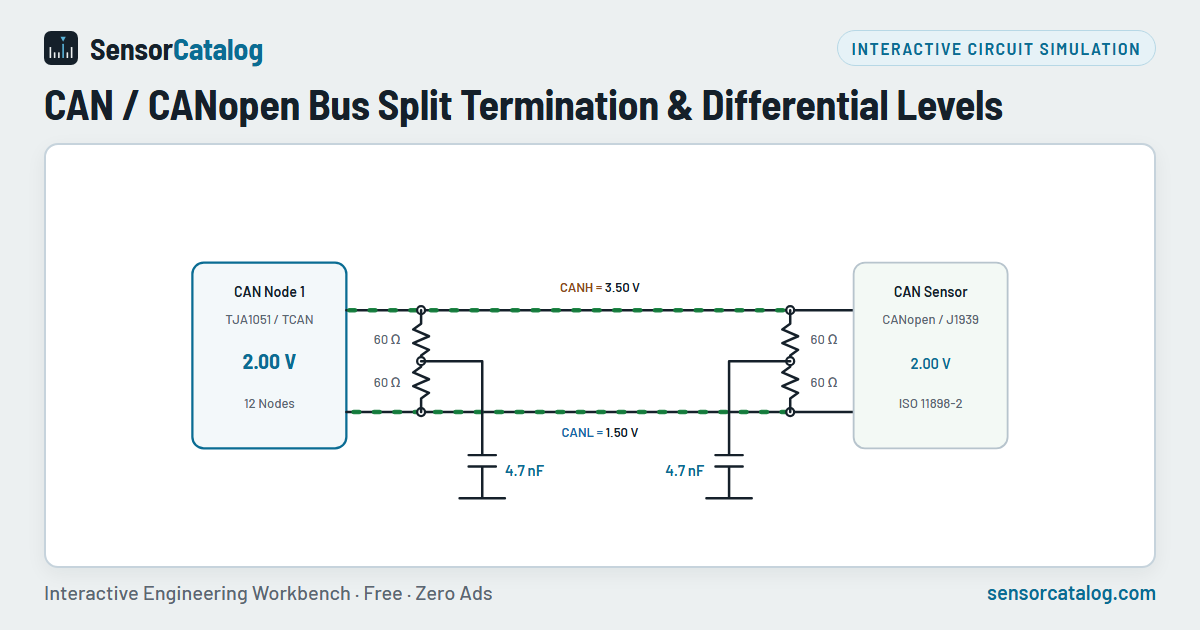
CAN / CANopen / J1939 (ISO 11898-2) is the dominant real-time bus for industrial robotics, mobile machinery, and automotive sensors. Proper 120 Ω termination at BOTH physical ends (60 Ω DC bus resistance) prevents reflections, while Split Termination (60 Ω + 60 Ω + 4.7 nF to GND) dramatically improves EMC common-mode noise rejection.
Dominant vs Recessive Signaling: In Recessive (logic 1), drivers release the bus to 2.5 V / 2.5 V (V_diff = 0 V). In Dominant (logic 0), a transmitter pulls CANH to ~3.5 V and CANL to ~1.5 V (V_diff ≈ 2.0 V) across the 60 Ω parallel termination load.
Split Termination EMC Magic: Splitting each 120 Ω into two 60 Ω resistors with a 4.7 nF capacitor from the center tap to GND leaves the 120 Ω differential impedance unchanged while forming a ~1.1 MHz low-pass filter that shunts high-frequency common-mode RF noise straight to ground!
2. Step-by-step: Terminating and commissioning an ISO 11898 CAN sensor bus
1Verify 60 Ω across CANH–CANL with power OFF
120 Ω means one end is missing; 40 Ω means a middle node accidentally left its terminator enabled!
2Use 60.4 Ω + 60.4 Ω + 4.7 nF (100 V X7R) split termination
Rate the split capacitor ≥ 100 V so it survives industrial bus-to-ground transients.
3Keep stub lengths < 0.3 m at 1 Mbps
Always daisy-chain sensor drops rather than star-wiring from a junction box.
4Add low-capacitance CAN ESD protection (PESD2CAN)
Keep TVS capacitance < 15 pF so high-speed 1 Mbps / CAN-FD edges stay crisp.
3. Field Troubleshooting & Multimeter Diagnostics
| Symptom | Root Cause | Multimeter Check | Corrective Fix |
|---|---|---|---|
| CAN works at 125 kbps but drops into Bus-Off at 500 kbps or 1 Mbps | Missing second 120 Ω terminator or excessive star-wired stub length | Measure power-off CANH–CANL resistance (should be ~60 Ω) and probe Dominant edges | Install matched 60+60 Ω split terminators at both physical cable ends only |
4. Frequently Asked Engineering Questions
Why do I measure 60 Ω instead of 120 Ω on a healthy CAN bus?
Because two 120 Ω terminators — one at each physical end of the bus — sit in parallel: 120 Ω || 120 Ω = 60 Ω.
5. Related Calculators, Guides & Other Sensor Circuits
- RS-485 cable, termination & biasing calculator
- Sensor supply voltage drop calculator
- I²C Bus Pull-Up & MOSFET Bidirectional Level Shifter Circuit
- RS-485 Transceiver Termination, Fail-Safe Bias & TVS Circuit
- Differential RS-422 Encoder & VR Speed Pickup Conditioning
- PNP (Sourcing) 3-Wire Sensor Output Circuit
- NPN (Sinking) 3-Wire Sensor Output Circuit
- NAMUR 2-Wire Intrinsic Safety Sensor Circuit
- 2-Wire 4–20 mA Current Loop & Protected Receiver Circuit