1. Présentation & principe de fonctionnement
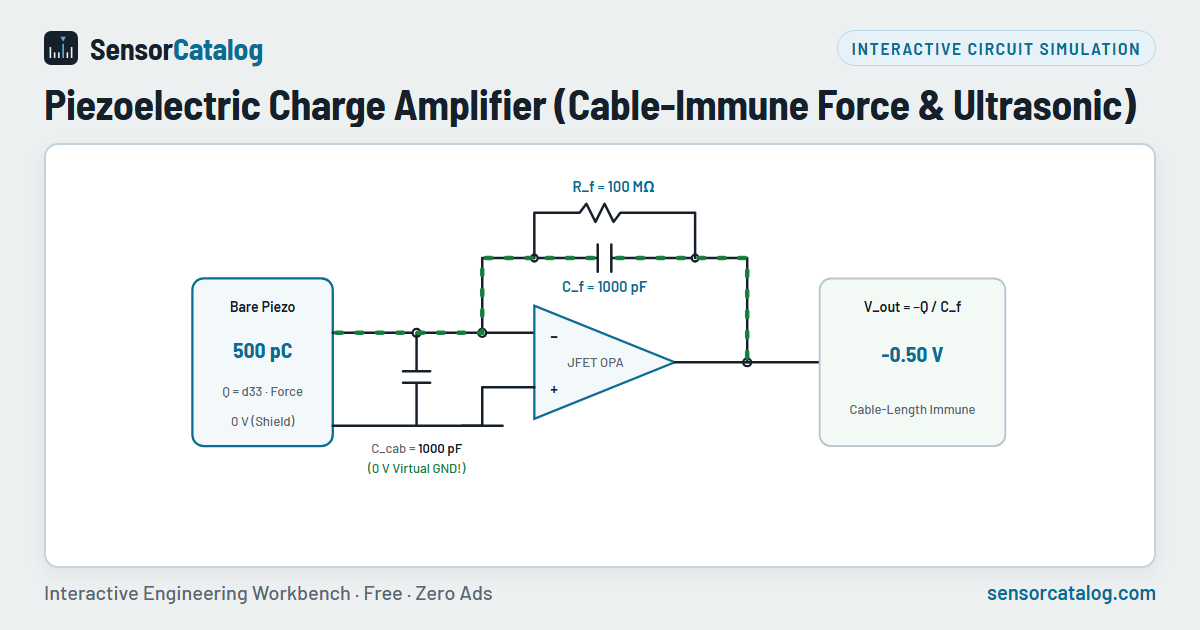
Unlike IEPE accelerometers with built-in electronics, bare piezoelectric crystals (force washers, ultrasonic transducers, high-temperature >250 °C vibration sensors) output pure electric charge Q (pC). A Charge Amplifier integrates Q across feedback capacitor C_f (V_out = −Q / C_f), making sensitivity 100% immune to coaxial cable length!
Cable-Capacitance Immunity: Because the op-amp inverting (−) terminal is held at 0 V virtual ground, the coaxial cable capacitance C_cab has 0 V across it and draws zero charge — all charge Q transfers directly into C_f.
Mandatory Gigaohm Reset Resistor R_f: Without R_f across C_f, picoamp op-amp bias current integrates continuously until output hits the supply rail. R_f stabilizes DC at 0 V and sets the low-frequency −3 dB cutoff f_LP = 1 / (2π · R_f · C_f).
2. Step-by-step: Designing a low-noise piezoelectric charge amplifier
1Pick C_f = Q_max / V_out(max) using C0G or polystyrene
1000 pF gives a clean 1.00 mV/pC transfer ratio with near-zero dielectric absorption.
2Select R_f for your required low-frequency cutoff f_LP
100 MΩ × 1000 pF yields f_LP = 1.59 Hz; use 1 GΩ for quasi-static 0.16 Hz force pulses.
3Choose a low-Ib, low-noise JFET op-amp (OPA657 / AD8610)
Remember that cable capacitance still amplifies op-amp voltage noise by Noise Gain = 1 + C_cab / C_f.
4Use low-triboelectric-noise coaxial cable for high-vibration runs
Standard RG58 generates fake pC charge spikes when flexed; graphite-lubricated low-noise piezo cables eliminate cable-whip artifacts.
3. Dépannage terrain & mesures au multimètre
| Symptôme | Cause racine | Contrôle multimètre | Action corrective |
|---|---|---|---|
| Output slowly drifts to −12 V rail after power-up with no force applied | Open/missing R_f or contaminated PCB leakage into summing node | Verify R_f continuity and wash summing node with IPA | Install 100 MΩ–1 GΩ R_f and add driven Guard Ring around (−) pin |
4. Questions fréquentes (FAQ)
Can a charge amplifier measure true static (DC) weight forever?
No — because R_f (and finite insulation resistance) gradually bleeds charge off C_f with time constant τ = R_f·C_f. Use a Wheatstone strain-gauge load cell for permanent static weighing.
5. Calculateurs associés, guides et autres circuits
- Calculateur capteur ultrasons
- Convertisseur de vibrations
- Calculateur de filtre RC anti-repliement
- Amplificateur Transimpédance (TIA) pour Photodiode
- Amplificateur Shunt de Courant High-Side vs Low-Side (Kelvin)
- Conditionnement Piézo / IEPE (ICP) Courant Constant & AC
- Comparateur à Hystérésis (Trigger de Schmitt) Anti-Rebond
- Transformateur de Courant AC (CT) : Charge, Biais Vref/2 & TVS
- Filtre RC Charge-Bucket (Kickback) pour ADC SAR & Établissement
- Potentiostat 3 Électrodes pour Capteur de Gaz Électrochimique
- Sortie Capteur PNP 3 Fils (Source) — Schéma & Simulateur
- Sortie Capteur NPN 3 Fils (Sink / Collecteur Ouvert)
- Circuit NAMUR 2 Fils Sécurité Intrinsèque (IEC 60947-5-6)
- Boucle de Courant 4–20 mA 2 Fils & Récepteur Protégé