1. Descripción general y principio de funcionamiento
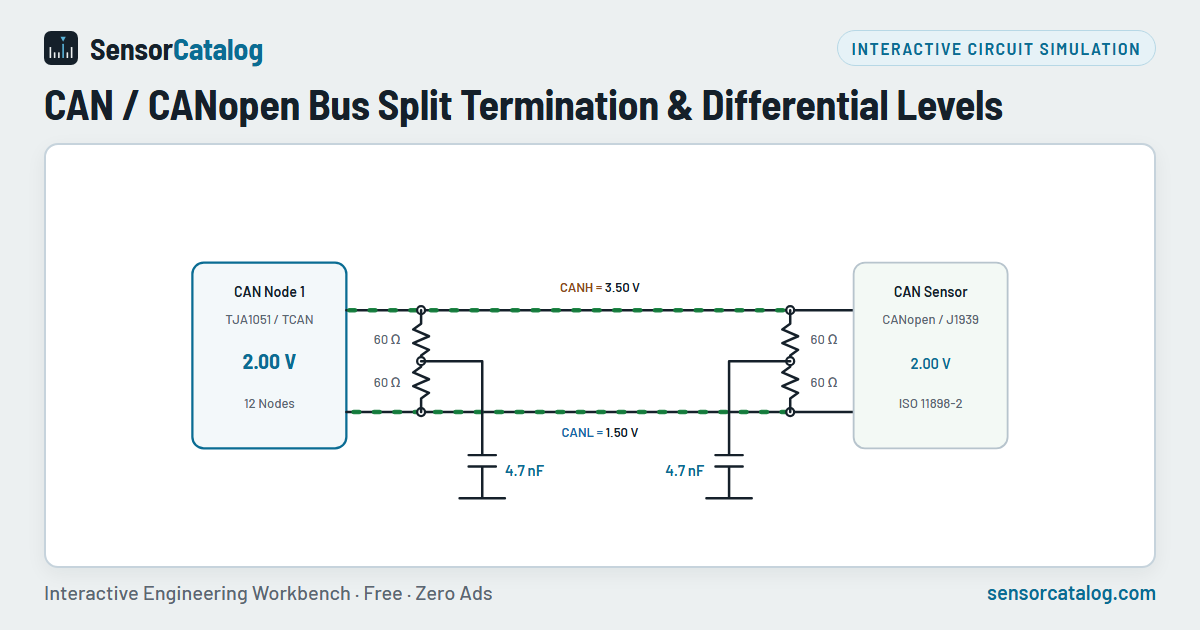
CAN / CANopen / J1939 (ISO 11898-2) is the dominant real-time bus for industrial robotics, mobile machinery, and automotive sensors. Proper 120 Ω termination at BOTH physical ends (60 Ω DC bus resistance) prevents reflections, while Split Termination (60 Ω + 60 Ω + 4.7 nF to GND) dramatically improves EMC common-mode noise rejection.
Dominant vs Recessive Signaling: In Recessive (logic 1), drivers release the bus to 2.5 V / 2.5 V (V_diff = 0 V). In Dominant (logic 0), a transmitter pulls CANH to ~3.5 V and CANL to ~1.5 V (V_diff ≈ 2.0 V) across the 60 Ω parallel termination load.
Split Termination EMC Magic: Splitting each 120 Ω into two 60 Ω resistors with a 4.7 nF capacitor from the center tap to GND leaves the 120 Ω differential impedance unchanged while forming a ~1.1 MHz low-pass filter that shunts high-frequency common-mode RF noise straight to ground!
2. Step-by-step: Terminating and commissioning an ISO 11898 CAN sensor bus
1Verify 60 Ω across CANH–CANL with power OFF
120 Ω means one end is missing; 40 Ω means a middle node accidentally left its terminator enabled!
2Use 60.4 Ω + 60.4 Ω + 4.7 nF (100 V X7R) split termination
Rate the split capacitor ≥ 100 V so it survives industrial bus-to-ground transients.
3Keep stub lengths < 0.3 m at 1 Mbps
Always daisy-chain sensor drops rather than star-wiring from a junction box.
4Add low-capacitance CAN ESD protection (PESD2CAN)
Keep TVS capacitance < 15 pF so high-speed 1 Mbps / CAN-FD edges stay crisp.
3. Diagnóstico en campo y pruebas con multímetro
| Síntoma | Causa raíz | Prueba con multímetro | Solución |
|---|---|---|---|
| CAN works at 125 kbps but drops into Bus-Off at 500 kbps or 1 Mbps | Missing second 120 Ω terminator or excessive star-wired stub length | Measure power-off CANH–CANL resistance (should be ~60 Ω) and probe Dominant edges | Install matched 60+60 Ω split terminators at both physical cable ends only |
4. Preguntas frecuentes (FAQ)
Why do I measure 60 Ω instead of 120 Ω on a healthy CAN bus?
Because two 120 Ω terminators — one at each physical end of the bus — sit in parallel: 120 Ω || 120 Ω = 60 Ω.
5. Calculadoras relacionadas, guías y otros circuitos
- Calculadora de cable, terminación y polarización RS-485
- Calculadora de caída de tensión de alimentación del sensor
- Pull-Up Bus I²C y Conversor de Nivel MOSFET Bidireccional
- RS-485: Terminación 120 Ω, Polarización Fail-Safe y TVS
- Encoder Diferencial RS-422 y Sensor Magnético VR (Cruce por Cero)
- Circuito de Salida PNP 3 Hilos (Sourcing) — Simulador
- Circuito de Salida NPN 3 Hilos (Sinking / Colector Abierto)
- Circuito NAMUR 2 Hilos Seguridad Intrínseca (IEC 60947-5-6)
- Lazo de Corriente 4–20 mA 2 Hilos y Receptor Protegido