1. 回路概要と動作原理
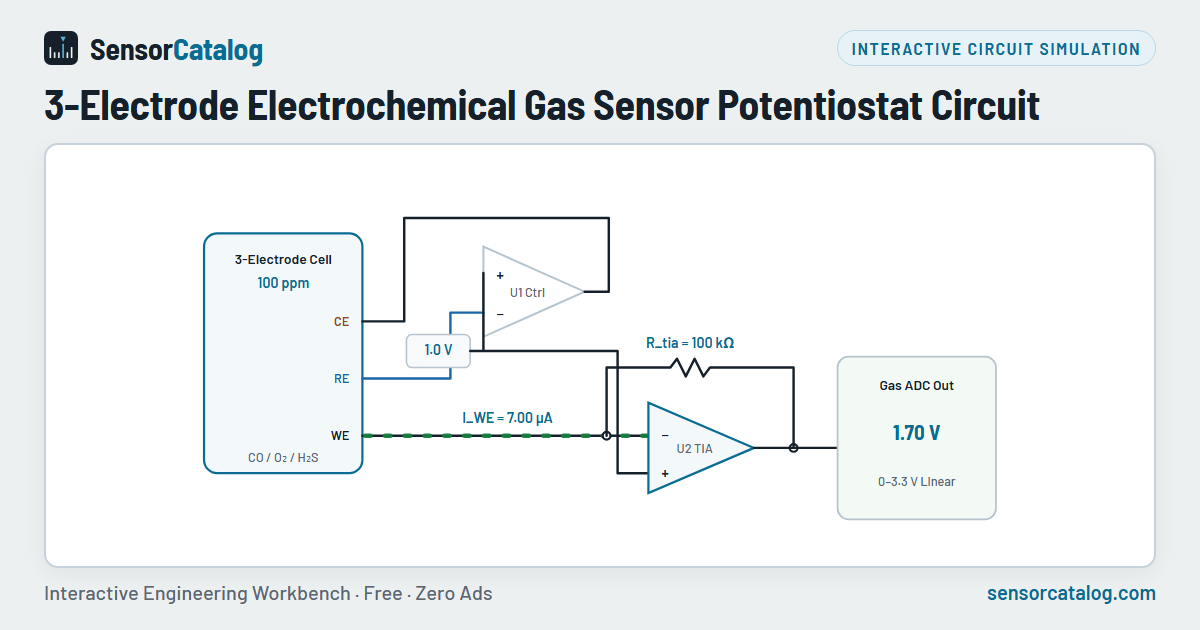
Toxic gas detectors (CO, H₂S, NO₂, SO₂, O₂) rely on 3-electrode electrochemical cells (Working WE, Reference RE, Counter CE). A dual-op-amp Potentiostat holds RE at an exact zero-current electrochemical bias via U1 while U2 converts nanoamp-to-microamp oxidation current at WE linearly into voltage.
Why 3 Electrodes Beat 2: Drawing current through the reference electrode polarizes it and ruins calibration. U1 senses RE with < 1 pA input current and drives whatever voltage is needed at CE to supply the full redox reaction current.
Depletion JFET Power-Off Shorting: Leaving WE–RE floating unpowered allows gas/humidity to polarize the cell — requiring up to 24 hours of stabilization upon reboot! A P-channel depletion JFET (MMBFJ177) automatically shorts WE to RE when Vcc = 0 V and opens once powered.
2. Step-by-step: Designing a low-power 3-electrode gas potentiostat
1Use zero-drift, picoamp-Ib op-amps (OPA2333 / LMP91000)
Microvolt offset drift and < 100 pA bias keep zero-gas baseline stable over −20…+50 °C.
2Size R_tia for full-scale ppm inside 0.2–3.1 V ADC window
Include 1.5× over-range headroom so alarm spikes do not saturate the TIA.
3Add a 10–33 Ω load resistor R_load in series with WE
Matches cell datasheet specification and stabilizes the TIA against large cell capacitance (~10–50 µF).
4Include depletion JFET shorting switch across WE–RE
Eliminates multi-hour warm-up delays in battery-powered portable detectors.
3. 現場トラブルシューティングとテスタ確認
| 症状 | 原因 | テスタ測定ポイント | 対策 |
|---|---|---|---|
| Detector reads 80 ppm in fresh air for hours after battery swap | Missing power-off WE–RE shorting JFET allowed cell electrodes to polarize while unpowered | Measure WE–RE voltage right after powering off | Install MMBFJ177 depletion JFET across WE–RE |
4. よくある技術質問(FAQ)
Do all electrochemical gas sensors use 0 mV bias between WE and RE?
No! CO and H₂S cells typically run at 0 mV bias, while NO, NH₃, and EtO cells require +200 mV to +300 mV bias between WE and RE (set via V_zero divider).
5. 関連計算ツール・比較ガイド・その他の回路
- ガス濃度換算ツール
- ADC 分解能計算ツール
- 電池寿命計算ツール
- フォトダイオード・トランスインピーダンスアンプ(TIA)回路
- ハイサイド vs ローサイド ケルビン電流シャント増幅回路
- 圧電/IEPE(ICP)定電流バイアス&ACカップリング回路
- ヒステリシス付きコンパレータ(シュミットトリガ)回路
- AC 変流器(CT)バーデン抵抗・Vref/2 バイアス&開放保護回路
- SAR ADC RC チャージバケット(キックバック)フィルタ&セトリング
- 圧電チャージアンプ(同軸ケーブル容量に無関係な電荷増幅)
- PNP(ソース型)3線式センサ出力回路シミュレータ
- NPN(シンク/オープンコレクタ)3線式センサ出力回路
- NAMUR 2線式本質安全防爆センサ回路(IEC 60947-5-6)
- 2線式 4–20 mA 電流ループ&ADC保護受信回路シミュレータ