1. 회로 개요 및 동작 원리
Toxic gas detectors (CO, H₂S, NO₂, SO₂, O₂) rely on 3-electrode electrochemical cells (Working WE, Reference RE, Counter CE). A dual-op-amp Potentiostat holds RE at an exact zero-current electrochemical bias via U1 while U2 converts nanoamp-to-microamp oxidation current at WE linearly into voltage.
Why 3 Electrodes Beat 2: Drawing current through the reference electrode polarizes it and ruins calibration. U1 senses RE with < 1 pA input current and drives whatever voltage is needed at CE to supply the full redox reaction current.
Depletion JFET Power-Off Shorting: Leaving WE–RE floating unpowered allows gas/humidity to polarize the cell — requiring up to 24 hours of stabilization upon reboot! A P-channel depletion JFET (MMBFJ177) automatically shorts WE to RE when Vcc = 0 V and opens once powered.
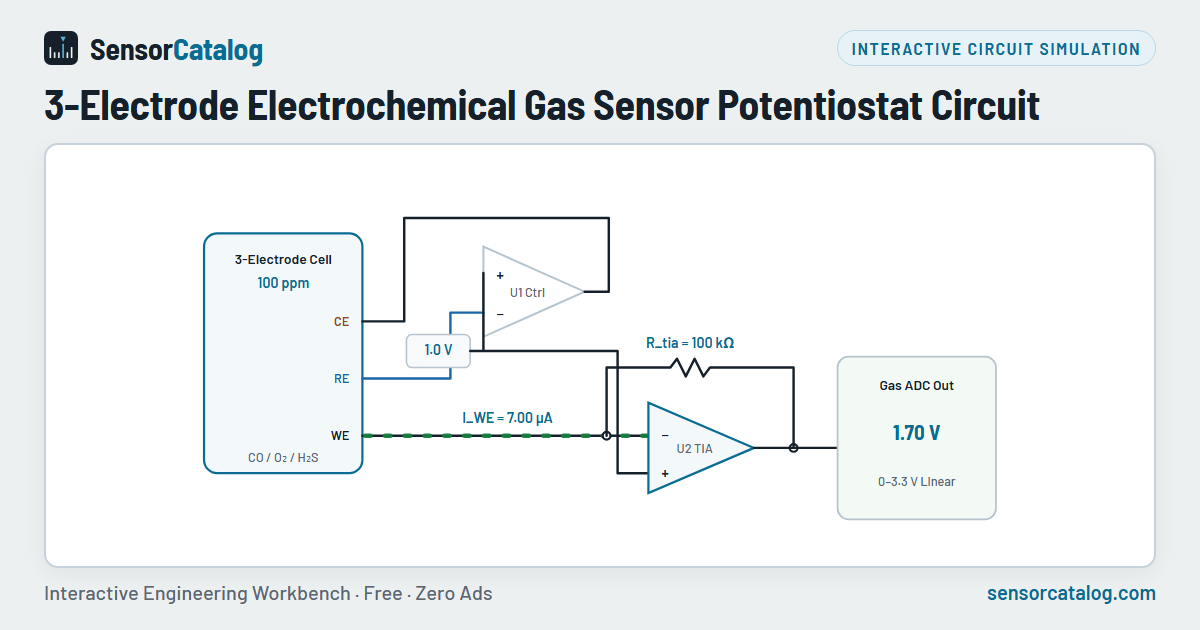
2. Step-by-step: Designing a low-power 3-electrode gas potentiostat
1Use zero-drift, picoamp-Ib op-amps (OPA2333 / LMP91000)
Microvolt offset drift and < 100 pA bias keep zero-gas baseline stable over −20…+50 °C.
2Size R_tia for full-scale ppm inside 0.2–3.1 V ADC window
Include 1.5× over-range headroom so alarm spikes do not saturate the TIA.
3Add a 10–33 Ω load resistor R_load in series with WE
Matches cell datasheet specification and stabilizes the TIA against large cell capacitance (~10–50 µF).
4Include depletion JFET shorting switch across WE–RE
Eliminates multi-hour warm-up delays in battery-powered portable detectors.
3. 현장 트러블슈팅 및 멀티미터 점검
| 증상 | 근본 원인 | 멀티미터 점검 | 조치 방법 |
|---|---|---|---|
| Detector reads 80 ppm in fresh air for hours after battery swap | Missing power-off WE–RE shorting JFET allowed cell electrodes to polarize while unpowered | Measure WE–RE voltage right after powering off | Install MMBFJ177 depletion JFET across WE–RE |
4. 자주 묻는 엔지니어링 질문 (FAQ)
Do all electrochemical gas sensors use 0 mV bias between WE and RE?
No! CO and H₂S cells typically run at 0 mV bias, while NO, NH₃, and EtO cells require +200 mV to +300 mV bias between WE and RE (set via V_zero divider).
5. 관련 계산기, 비교 가이드 및 다른 센서 회로
- 가스 농도 변환기
- ADC 분해능 계산기
- 배터리 수명 계산기
- 포토다이오드 트랜스임피던스 증폭기 (TIA) 회로
- 하이사이드 vs 로우사이드 켈빈 전류 션트 증폭 회로
- 압전 / IEPE (ICP) 정전류 바이어스 & AC 커플링 회로
- 히스테리시스 비교기 (슈미트 트리거) 임계값 검출 회로
- AC 변류기(CT) 버든 저항, Vref/2 바이어스 & 개방 고압 보호
- SAR ADC RC 차지 버킷(킥백) 필터 & 세틀링 시간 검증
- 압전 차지 앰프 (동축 케이블 정전용량 무관 전하 증폭)
- PNP (소싱) 3선식 센서 출력 회로 시뮬레이터
- NPN (싱킹 / 오픈컬렉터) 3선식 센서 출력 회로
- NAMUR 2선식 본질안전 방폭 센서 회로 (IEC 60947-5-6)
- 2선식 4–20 mA 전류 루프 & ADC 보호 수신 회로