1. Überblick & Funktionsprinzip
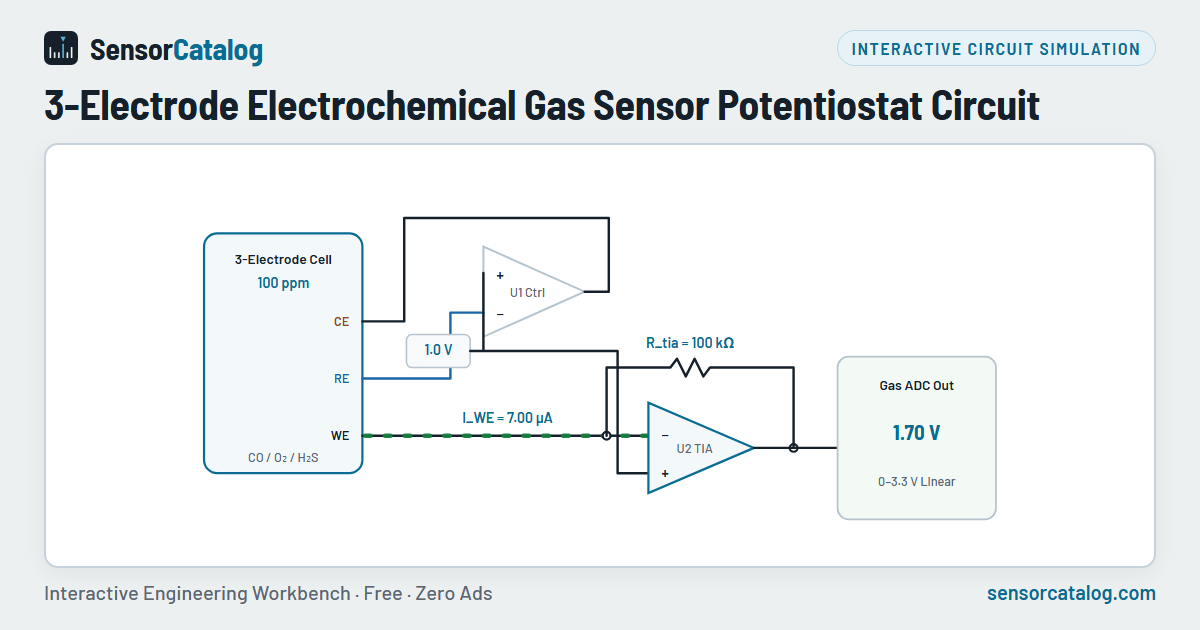
Toxic gas detectors (CO, H₂S, NO₂, SO₂, O₂) rely on 3-electrode electrochemical cells (Working WE, Reference RE, Counter CE). A dual-op-amp Potentiostat holds RE at an exact zero-current electrochemical bias via U1 while U2 converts nanoamp-to-microamp oxidation current at WE linearly into voltage.
Why 3 Electrodes Beat 2: Drawing current through the reference electrode polarizes it and ruins calibration. U1 senses RE with < 1 pA input current and drives whatever voltage is needed at CE to supply the full redox reaction current.
Depletion JFET Power-Off Shorting: Leaving WE–RE floating unpowered allows gas/humidity to polarize the cell — requiring up to 24 hours of stabilization upon reboot! A P-channel depletion JFET (MMBFJ177) automatically shorts WE to RE when Vcc = 0 V and opens once powered.
2. Step-by-step: Designing a low-power 3-electrode gas potentiostat
1Use zero-drift, picoamp-Ib op-amps (OPA2333 / LMP91000)
Microvolt offset drift and < 100 pA bias keep zero-gas baseline stable over −20…+50 °C.
2Size R_tia for full-scale ppm inside 0.2–3.1 V ADC window
Include 1.5× over-range headroom so alarm spikes do not saturate the TIA.
3Add a 10–33 Ω load resistor R_load in series with WE
Matches cell datasheet specification and stabilizes the TIA against large cell capacitance (~10–50 µF).
4Include depletion JFET shorting switch across WE–RE
Eliminates multi-hour warm-up delays in battery-powered portable detectors.
3. Fehlersuche & Multimeter-Diagnose
| Symptom | Ursache | Multimeter-Prüfung | Abhilfe |
|---|---|---|---|
| Detector reads 80 ppm in fresh air for hours after battery swap | Missing power-off WE–RE shorting JFET allowed cell electrodes to polarize while unpowered | Measure WE–RE voltage right after powering off | Install MMBFJ177 depletion JFET across WE–RE |
4. Häufige technische Fragen (FAQ)
Do all electrochemical gas sensors use 0 mV bias between WE and RE?
No! CO and H₂S cells typically run at 0 mV bias, while NO, NH₃, and EtO cells require +200 mV to +300 mV bias between WE and RE (set via V_zero divider).
5. Zugehörige Rechner, Leitfäden & weitere Schaltungen
- Gaskonzentrations-Rechner
- Rechner für ADC-Auflösung
- Rechner für die Batterielaufzeit
- Fotodioden-Transimpedanzverstärker (TIA) Schaltung
- Low-Side vs High-Side Strommess-Shunt (Kelvin 4-Leiter)
- Piezo / IEPE (ICP) Konstantstrom- & AC-Kopplungsschaltung
- Komparator mit Hysterese (Schmitt-Trigger) Schwellwertschalter
- AC-Stromwandler (CT): Bürdenwiderstand, Vref/2-Bias & TVS
- SAR-ADC RC Charge-Bucket-Filter (Kickback & Einschwingzeit)
- Piezoelektrischer Ladungsverstärker (Kabelkapazitäts-immun)
- PNP-Schaltausgang (3-Leiter, Plus-schaltend) — Schaltung & Simulator
- NPN-Schaltausgang (3-Leiter, Minus-schaltend) — Schaltung & Simulator
- NAMUR 2-Leiter Eigensicherheits-Schaltung (IEC 60947-5-6)
- 2-Leiter 4–20 mA Stromschleife & geschützter Empfänger