1. 回路概要と動作原理
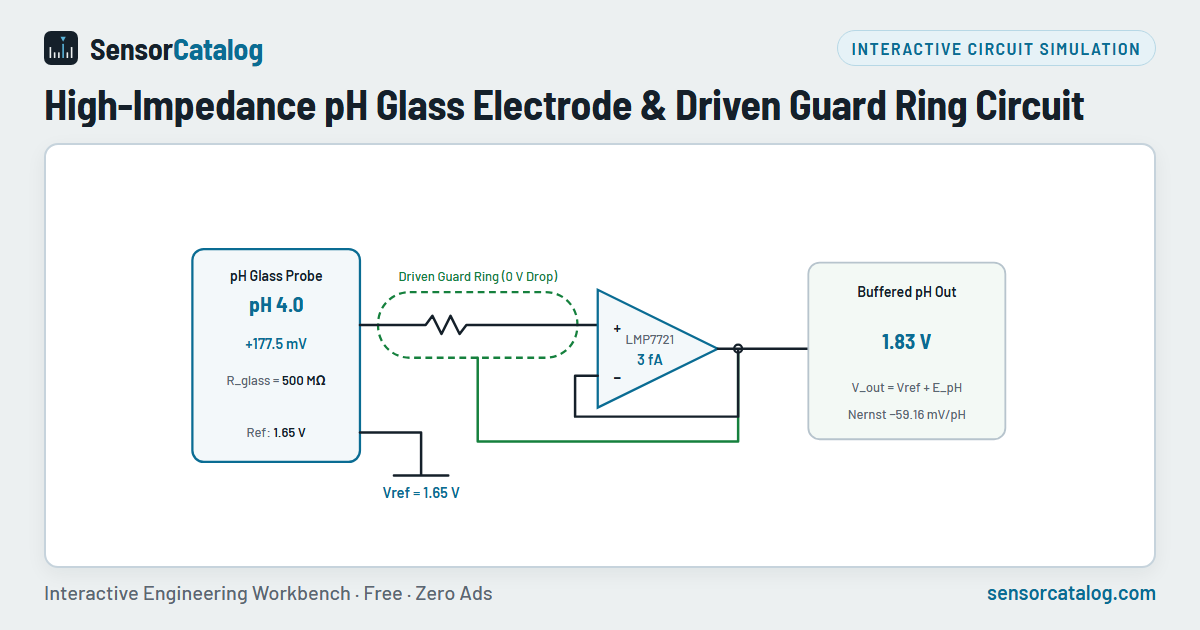
A pH glass electrode is one of the highest-impedance sensors in engineering: 100 MΩ to 1 GΩ source resistance generating ±414 mV via the Nernst equation (−59.16 mV/pH at 25 °C). Measuring it accurately requires a femtoamp-bias op-amp (LMP7721 / LMC6001), a driven Guard Ring around the input pin, and a precision mid-rail Vref shift.
Why Ordinary Op-Amps Fail Catastrophically: Even a "good" 1 nA input-bias op-amp flowing through a 500 MΩ glass bulb creates 1 nA × 500 MΩ = 500 mV error — more than 8 full pH units! Only fA-class amplifiers (Ib = 3 fA → 1.5 µV error) preserve ±0.01 pH accuracy.
Driven Guard Ring Physics: Surrounding the high-Z BNC center pin with a bare copper ring driven by the unity-gain buffer output keeps the potential difference across the FR4 surface at 0.000 V, reducing PCB moisture leakage current to zero!
2. Step-by-step: Building a ±0.01 pH glass-electrode front-end
1Select a femtoamp-class unity buffer (LMP7721 / LMC6001)
LMP7721 provides dedicated empty guard pins right next to the input pin for effortless PCB guard routing.
2Bias the reference electrode to a clean 1.65 V / 2.048 V Vref
Shifts the ±414 mV Nernst swing cleanly into 1.2–2.1 V on a single 3.3 V rail.
3Route an exposed-copper driven Guard Ring on top and bottom layers
Remove solder mask over the guard ring and ultrasonically wash all rosin flux residue.
4Measure solution temperature (PT1000/NTC) for Nernst slope ATC
Slope shifts from −54.2 mV/pH at 0 °C to −64.1 mV/pH at 50 °C — ATC is mandatory outside 25 °C.
3. 現場トラブルシューティングとテスタ確認
| 症状 | 原因 | テスタ測定ポイント | 対策 |
|---|---|---|---|
| pH reading jumps wildly whenever a hand approaches the board | Unshielded high-impedance BNC/trace picking up 50/60 Hz capacitive body hum | Place grounded metal shield over front-end and check stability | Use PTFE coaxial BNC, driven Guard Ring, and metal EMI shield can |
4. よくある技術質問(FAQ)
Why is the pH electrode voltage 0 mV at pH 7.00?
Because the internal reference buffer inside the glass bulb is formulated at pH 7.00, so zero hydrogen-ion concentration gradient exists across the glass membrane at neutral pH 7.