1. Présentation & principe de fonctionnement
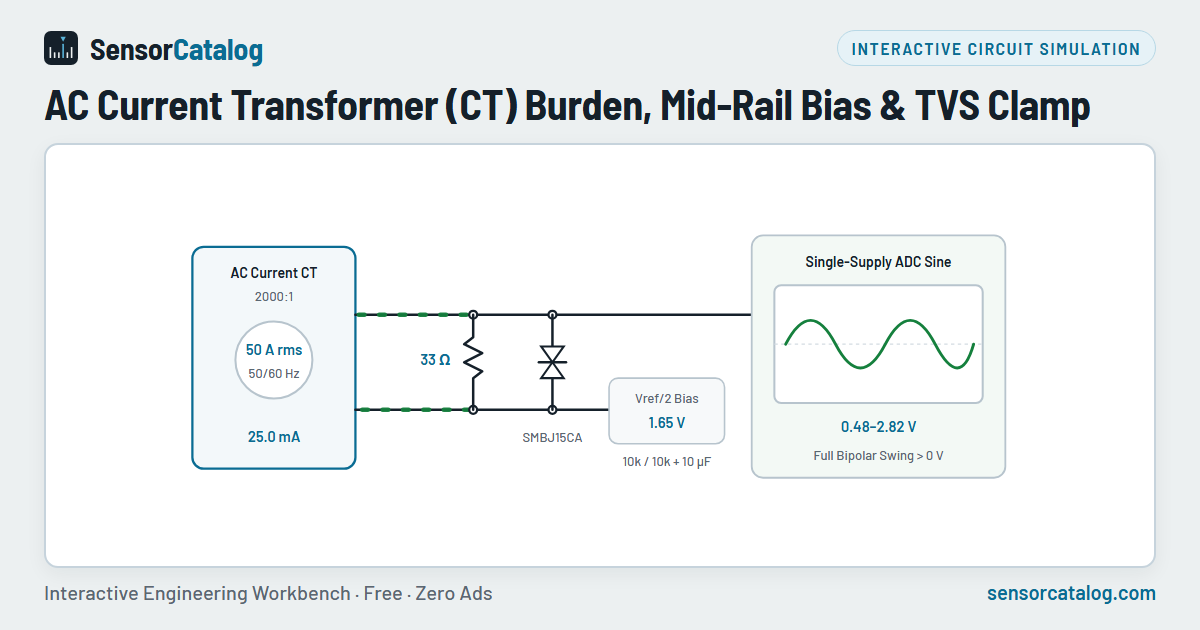
An AC Current Transformer (CT) such as SCT-013-000 outputs an isolated AC secondary current proportional to mains load current. To sample both half-cycles with a single-supply 3.3 V MCU ADC, you need three essentials: a precision burden resistor R_B, a low-impedance Vref/2 mid-rail bias, and a bidirectional TVS across the secondary to prevent lethal open-circuit high voltage.
Burden Sizing & Crest Factor: Peak secondary current is I_rms × √2 / N. Choose R_B so V_pk = I_sec(pk) × R_B stays below 0.85 × (Vref / 2) to leave margin for non-sinusoidal motor/SMPS current crests.
Why Open-CT Secondary Is Dangerous: A CT forces magnetic flux to drive current; if R_B disconnects, secondary voltage spikes above 100–300 V, arcing across connectors and destroying insulation. A bidirectional SMBJ15CA TVS clamps open-circuit spikes safely.
2. Step-by-step: Interfacing an AC current transformer to a 3.3 V ADC
1Calculate max burden R_B from peak primary current and turns ratio
Use R_B ≤ (Vref / 2 × 0.85) / (I_max × √2 / N) and pick a 1% low-tempco metal-film resistor.
2Build a low-impedance Vref/2 mid-rail bias with 10 µF bypass
Two equal 10 kΩ resistors + 10 µF capacitor give < 0.3 Ω AC impedance at 50/60 Hz so the CT reference stays rock-steady.
3Solder bidirectional TVS directly across the CT terminal block
SMBJ15CA stays completely invisible during ±1.5 V normal operation yet clamps open-burden faults instantaneously.
4Sample at ≥ 2 kHz and compute true RMS after subtracting DC bias
Subtract the running mean of each full mains cycle before squaring so Vref/2 resistor tolerance introduces zero error.
3. Dépannage terrain & mesures au multimètre
| Symptôme | Cause racine | Contrôle multimètre | Action corrective |
|---|---|---|---|
| RMS reading flattens out above 60 A even though load is 100 A | Burden resistor too large — AC peaks clipping at 0 V and 3.3 V rails | Inspect ADC pin on oscilloscope for flat-topped sine wave | Reduce R_B (e.g. 68 Ω → 33 Ω) and recalibrate firmware scale factor |
4. Questions fréquentes (FAQ)
Can a CT measure DC battery or solar current?
No — a transformer requires changing magnetic flux (AC). For DC current, use a Kelvin shunt amplifier or Hall-effect current sensor.
Why is the 10 µF capacitor on the Vref/2 divider mandatory?
Without it, the 10 kΩ || 10 kΩ = 5 kΩ divider impedance sits in series with the CT burden, collapsing the AC signal into a tiny fraction.
5. Calculateurs associés, guides et autres circuits
- Calculateur de charge de transformateur de courant
- Calculateur de résolution d’un CAN
- Amplificateur Transimpédance (TIA) pour Photodiode
- Amplificateur Shunt de Courant High-Side vs Low-Side (Kelvin)
- Conditionnement Piézo / IEPE (ICP) Courant Constant & AC
- Comparateur à Hystérésis (Trigger de Schmitt) Anti-Rebond
- Filtre RC Charge-Bucket (Kickback) pour ADC SAR & Établissement
- Potentiostat 3 Électrodes pour Capteur de Gaz Électrochimique
- Amplificateur de Charge Piézoélectrique (Immunisé au Câble)
- Sortie Capteur PNP 3 Fils (Source) — Schéma & Simulateur
- Sortie Capteur NPN 3 Fils (Sink / Collecteur Ouvert)
- Circuit NAMUR 2 Fils Sécurité Intrinsèque (IEC 60947-5-6)
- Boucle de Courant 4–20 mA 2 Fils & Récepteur Protégé