1. Présentation & principe de fonctionnement
IEPE (Integrated Electronics Piezo-Electric, also known as ICP® per ISO 5348) is the universal 2-wire interface for industrial vibration accelerometers on rotating machinery, turbines, motors, and wind gearboxes.
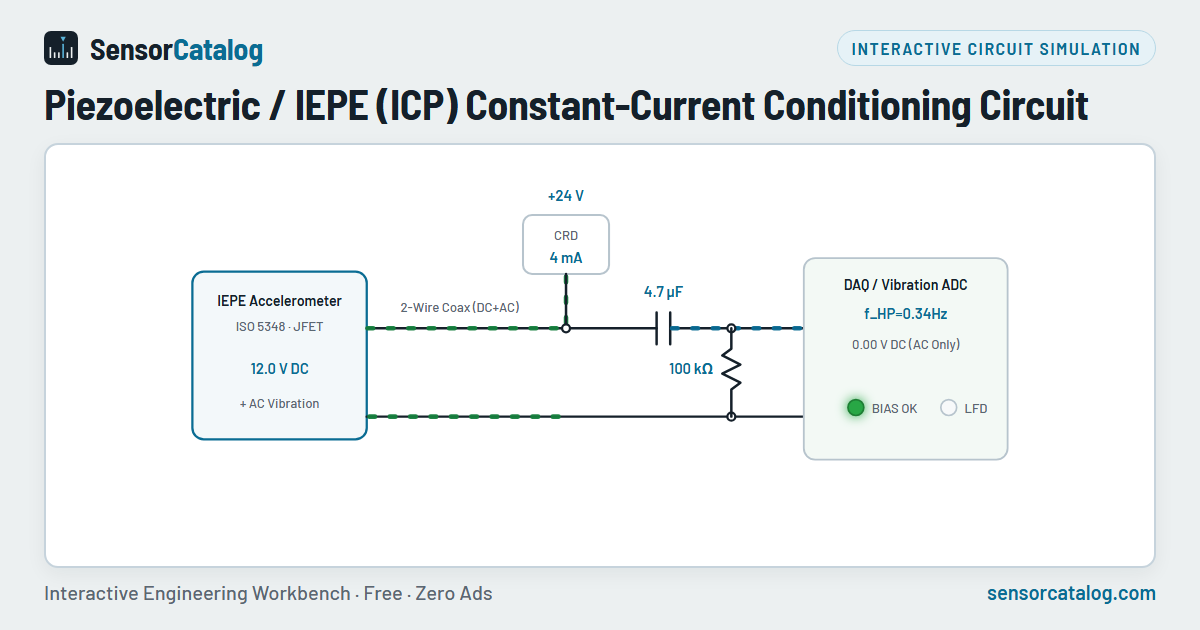
A single coaxial cable carries BOTH the 2–4 mA constant-current DC excitation power (~12 V DC bias) AND the high-frequency AC vibration waveform (up to >10 kHz), while an AC coupling capacitor blocks the 12 V DC from the ADC and a DC bias window monitor provides automatic Open/Short cable diagnostics!
Why 2-Wire Constant Current? Raw piezoelectric crystals have Gigaohm output impedance and pick up severe cable triboelectric noise. IEPE puts a tiny JFET impedance converter right inside the accelerometer, lowering output impedance to <100 Ω so standard coax can run >100 m cleanly!
Built-In Cable Health & High-Pass Corner: A healthy IEPE accelerometer sits squarely inside the 8–16 V DC bias window (~12 V). Open BNC cable jumps bias to Vs (24 V > 18 V); crushed shorted coax drops bias to <2 V! Meanwhile Cc and Rb set the low-frequency cutoff f_HP = 1 / (2π·Rb·Cc) — keep f_HP ≤ 1–2 Hz to capture ISO 20816 10 Hz vibration flatly.
2. Step-by-step: Building an IEPE / ICP accelerometer signal conditioner
1Build a clean 24 V / 4 mA constant-current source (CRD or LM334)
Use a low-noise linear 24 V rail feeding a 4 mA constant-current diode (1N5314 / E-452) or precision current source (LM334 + temp-comp diode) into the BNC center pin.
2Size AC coupling Cc and Rb for f_HP ≤ 0.5–2 Hz
Pick a low-leakage film or non-polar capacitor (e.g. 4.7 µF, ≥35 V) with Rb = 100 kΩ (f_HP = 0.34 Hz). Remember larger Cc takes ~5·Rb·Cc seconds to settle after power-up!
3Add a DC bias window comparator for Open (>18 V) / Short (<2 V) LFD
Tap the coax BEFORE Cc through a 100 kΩ / 10 kΩ divider into a slow MCU ADC channel: >18 V = Open Cable, <2 V = Short Cable, 8–16 V = Healthy!
4Add ADC protection clamp diodes for turn-on capacitor surge
At power-on or hot-plugging an IEPE sensor, Cc transmits a brief 24 V step transient into the ADC! Add a 1 kΩ series resistor + BAT54S clamp diodes after Cc.
3. Dépannage terrain & mesures au multimètre
| Symptôme | Cause racine | Contrôle multimètre | Action corrective |
|---|---|---|---|
| Vibration readings slowly drift for 10 seconds after plugging in the sensor | Normal charging of AC coupling capacitor Cc to 12 V DC bias (τ = Rb × Cc) | Calculate 5 × Rb × Cc (e.g. 5 × 100 kΩ × 4.7 µF = 2.35 s) | Wait for settling after hot-plug, or add a fast-charge pre-bias switch in DAQ firmware |
| High-frequency vibration (>5 kHz) clips or distorts on a 100 m cable | Insufficient constant current (2 mA) to slew cable capacitance at high frequency (I = 2π·f·C·V) | Calculate required slew current for your cable capacitance (~100 pF/m) and peak voltage | Increase IEPE constant-current excitation from 2 mA to 4–10 mA |
4. Questions fréquentes (FAQ)
Can an IEPE accelerometer measure static DC acceleration (0 Hz / gravity tilt)?
No! Both the piezoelectric crystal and the AC coupling capacitor block DC (0 Hz). IEPE measures dynamic vibration (typically 0.5 Hz to 10+ kHz). For DC tilt/static g, use a MEMS capacitive accelerometer.
Why is 24 V compliance voltage needed when the accelerometer bias is only 12 V?
A ±5 V peak vibration signal rides ON TOP of the 12 V DC bias (swinging from 7 V to 17 V), plus the constant-current regulator needs ≥3–4 V dropout headroom — requiring at least 21–24 V supply to avoid clipping large shock peaks!
Can I use an electrolytic capacitor for IEPE AC coupling Cc?
Avoid aluminum electrolytics if possible: their DC leakage current creates noisy offset across Rb and degrades low-frequency performance. Prefer polypropylene/polyester film capacitors (or low-leakage tantalum with strict polarity).
How does IEPE detect a broken or shorted cable automatically?
By monitoring the DC voltage on the coax before Cc: healthy sensors sit at 8–16 V (~12 V), an open cable rails to the 24 V supply (>18 V), and a shorted cable collapses below 2 V.
Why should IEPE cable shields be grounded only at the DAQ side?
Industrial accelerometers use electrically isolated bases (or mounting pads) so the coax shield connects to ground ONLY at the DAQ chassis — eliminating 50/60 Hz ground-loop hum in the vibration spectrum.
Is ICP the same standard as IEPE?
Yes! IEPE is the vendor-neutral generic name, while ICP® (PCB Piezotronics), DeltaTron (Brüel & Kjær), and Isotron (Endevco) are brand trademarks for the exact same 2-wire 2–4 mA constant-current interface.
5. Calculateurs associés, guides et autres circuits
- Convertisseur de vibrations
- Calculateur d’intensité vibratoire
- Calculateur de fréquences de défauts de roulement
- Amplificateur Transimpédance (TIA) pour Photodiode
- Amplificateur Shunt de Courant High-Side vs Low-Side (Kelvin)
- Comparateur à Hystérésis (Trigger de Schmitt) Anti-Rebond
- Transformateur de Courant AC (CT) : Charge, Biais Vref/2 & TVS
- Filtre RC Charge-Bucket (Kickback) pour ADC SAR & Établissement
- Potentiostat 3 Électrodes pour Capteur de Gaz Électrochimique
- Amplificateur de Charge Piézoélectrique (Immunisé au Câble)
- Sortie Capteur PNP 3 Fils (Source) — Schéma & Simulateur
- Sortie Capteur NPN 3 Fils (Sink / Collecteur Ouvert)
- Circuit NAMUR 2 Fils Sécurité Intrinsèque (IEC 60947-5-6)
- Boucle de Courant 4–20 mA 2 Fils & Récepteur Protégé